
Finally, break free from the German bureaucratic maze and get one step closer to your dream life in Germany!
Sworn translation from English, Spanish, Catalan, and Galician into German—accepted within the whole of Germany
Is German bureaucracy a nightmare for you, but you want to have your degree recognized in Germany, get married in Germany, or study there? No more detours, delays, or complete setbacks: With my sworn translations, you’ll finally reach your goal!
What the heck?!
You are about to experience a very special moment in your life. Perhaps you want to
- fulfill your childhood dream of studying at a top German university after all these years?
- pull up stakes in your old home to build the life of your dreams in Germany?
- or put an end to that difficult long-distance relationship and finally marry the love of your life in Germany?
There’s just one problem: German bureaucracy. Opaque, outrageously tedious, and overly complicated.
“What do they want from me? Nobody can make heads or tails of it anymore.” We’ve probably all been there, done that, right? (Yes, even Germans complain a lot about bureaucracy).
They cannot be serious?!
Finally, the most important things are all set for the big day. The venue has been confirmed, the invitations have been sent out, the caterer is booked, and all the documents have been translated (who said getting married had to be so much work, by the way?).
And then the shock: “We only accept translations from a translator sworn in Germany, so I can’t accept your birth certificate.” Seriously?!
So now you have to start looking for a translator all over again (and, above all, figure out where to find sworn translators in the first place).
Couldn’t they have mentioned that sooner?
Found a certified translator? Check. Resubmitted the translation? Check. And now the registry office is freaking out again: “Since you weren’t born in an EU member state, we still need an apostille for the birth certificate.”
What the heck is an apostille—and more importantly, where can you get one on short notice?

Green light: One less item on the (already way too long) to-do list!
Whether it’s a wedding, the birth of your child, or a new job in Germany: German authorities will require a sworn or certified translation from you (great, even more running around from A to B!).
But what does that actually mean?
A sworn or certified translation is done by a translator who has been appointed by a German court and who affixes a stamp and a signature to the document. An “official” translation, so to speak. And the only translation that is usually accepted by German authorities and institutions.
Bye bye frustration caused by dealing with German authorities and more time for the good things in life—thanks to sworn translations
What documents do you actually need for marriage, professional certification, divorce, etc. in Germany?
Do I need an apostille or legalization for my documents?
How do I know if the authority will accept the translation?
Is a digital version sufficient, or do they insist on the hard copy?
How are you supposed to know all of this? But don’t worry—you don’t have to wade through this incomprehensible bureaucratic jargon on your own.
Simply bring a sworn translator on board who can advise you accordingly and translate your official documents from English, Spanish, Catalan, and/or Galician into German in a way that German authorities are sure to accept.
Your Compass Through the German Maze of Bureaucracy
Order a sworn translation from me so you can get back to focusing on the good things in life. That’s part of our journey together:
-
Comprehensive Consulting
To get started, please send me your documents and provide me with some information about your plans. This will allow me to assess and, if necessary, research which documents are truly required in your case. -
Professional Translation
I translate your documents in accordance with legal requirements and the guidelines of the Professional Association of Interpreters and Translators (BDÜ). This way, my translation will be accepted by the authorities. -
Multilingual? No Problem
If your document is multilingual, you’ll usually need to hire multiple translators. If your document is written in English, Spanish, Catalan, and/or Galician, I can translate your entire document in one go. -
Nationwide Recognition
The Halle (Saale) Regional Court has certified me as a translator for English, Spanish, Catalan, and Galician. This means you can be sure that your translation will be recognized not only in Saxony-Anhalt but throughout Germany. -
Fair Prices
I bill for my certified translations in accordance with the JVEG, a German law regulating reasonable fees for experts, interpreters, and translators. You can therefore expect fair, market-standard prices from me. -
Fast Delivery
I typically translate documents ranging from one to five pages within three business days (or even faster if needed). This means I can help you out with a certified translation even in an emergency, right up until the deadline.
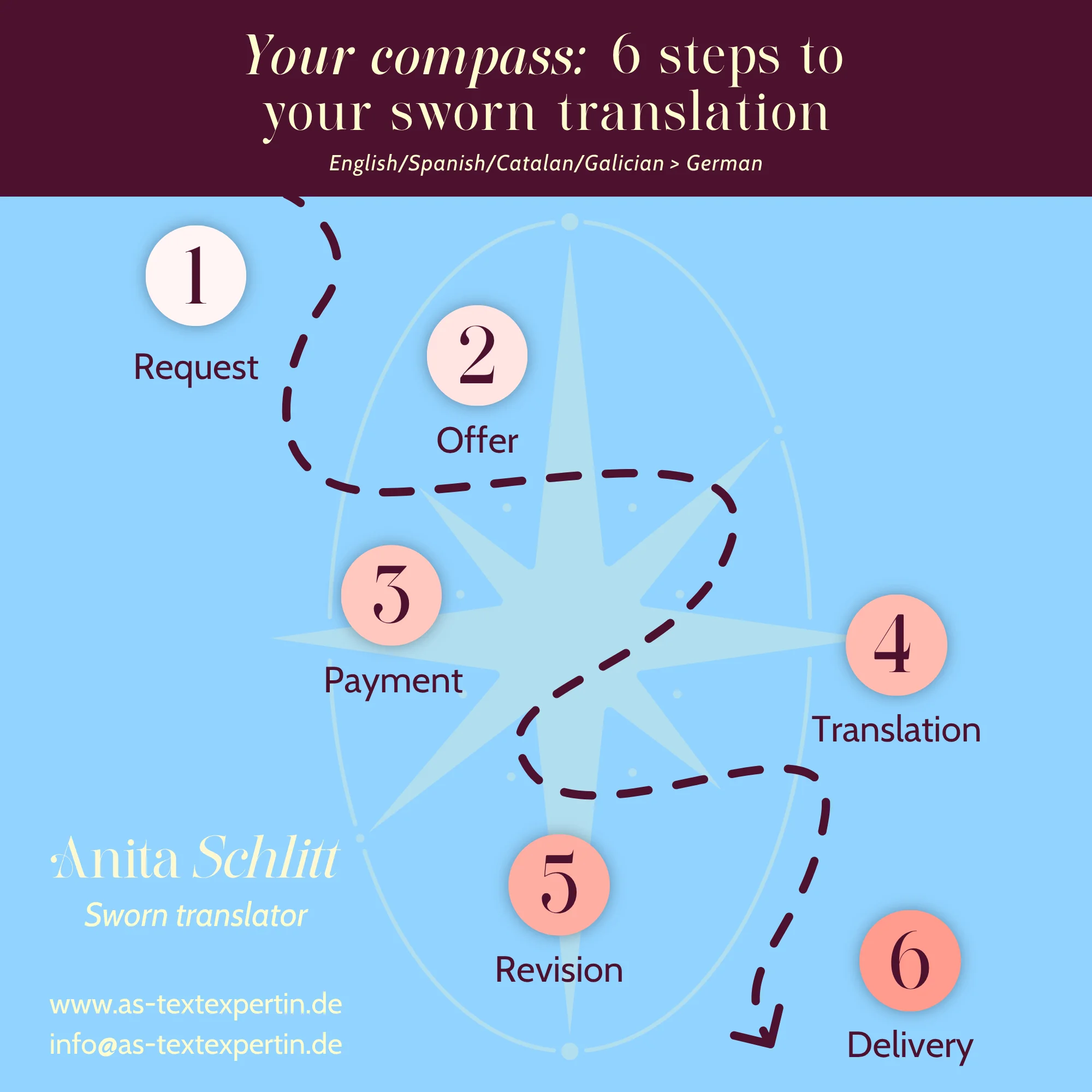
This is what our journey with a sworn translation into German looks like:
Request
You send me your scanned documents with a bit of information on your plans via email.
Offer
I will send you a free offer with the estimated costs and delivery date.
Payment
Our contract is concluded once you make your payment via bank transfer or PayPal.
Translation
I will translate your document in accordance with current regulations and legal requirements.
Revision
After the translation is complete, you may review your personal information in the draft once.
Delivery
You will receive a digitally signed translation and/or a scan and the hard copy by mail.
What others say about our journey out of the German bureaucratic maze:
Furthermore, Ms. Schlitt was always available, and communicating with her was consistently straightforward. Her friendly, trustworthy, and helpful manner made working with her a true pleasure. Thank you very much for the excellent service!”
Who is your compass through the German maze of bureaucracy?
(H)ola, my name is Anita Schlitt, sworn translator for the English, Spanish, Catalan, and Galician language in Halle (Saale). I became a freelance translator right after my bachelor’s degree in Translation and Interpretation in 2024.
Right from the beginning of my freelance career, I wanted to become a sworn translator. But this turned out to be pretty complicated (not to mention all the bureaucratic hurdles that self-employment in Germany comes with—of course!).
Since I had to find my own way through the German maze of bureaucracy to get certified, I’ve now taken on this task for my professional association, the German Association of Interpreters and Translators (BDÜ). I’m the contact person there for my colleagues in Saxony-Anhalt regarding matters of sworn translators and interpreters.
I’d be happy to be your personal advisor—let’s start your journey out of the German maze of bureaucracy together!
I often get these questions about dealing with the German maze of bureaucracy:
What is a sworn or certified translation?
A sworn or certified translation is a translation made by a translator authorized in Germany—basically an “official” translation for German authorities and institutions. In Germany, it is supposed to serve as a guide to help readers who don’t speak the language of the original to understand it. Therefore, it should be as close as possible to the original’s format. In addition to the actual translation, a sworn translation includes a stamp, a signature, and a certification statement confirming that the translation is complete and accurate in terms of content.
From and into which languages do you translate?
I am a sworn translator for English, Spanish, Catalan, and Galician, and I translate from these four languages into German. In addition, I can also translate a German document into one of these four languages; however, an apostille may be required for my translation to be recognized abroad. If this is the case, I will, of course, inform you in my quote. For a service fee, I can also take care of requesting the apostille on your behalf.
What's the difference between “sworn”, “certified” and all these German names for this type of translation?
Unfortunately, the official term always depends on the country (and even within Germany, we don’t have a standard term for it). In German, the most frequent name would be “beglaubigte Übersetzung”, although technically as a sworn translator in Germany, I cannot authorize a document. Other German names are “bestätigte” or “bescheinigte Übersetzung” or “Urkundenübersetzung”. Yes, all of these are synonyms.
Is there a difference between a “vereidigter” and “beeidigter” or “ermächtigter Übersetzer”?
That depends on the federal state in which the person was sworn in. As with the translations themselves, there are different terms used here, though they are all synonyms. I was sworn in by the state of Saxony-Anhalt, but my translations are valid throughout Germany.
Will your translations be accepted in Berlin, Frankfurt, Munich, etc.?
Yes, my certified translations are recognized throughout Germany in accordance with the German Code of Civil Procedure, even though I was sworn in as a translator in Saxony-Anhalt.
How much is a sworn translation?
The cost of a sworn translation always depends on the specific document. Is it difficult to read, or perhaps even handwritten (yes, that happens)? Does the document contain many tables that are time-consuming to recreate? Do I need to do a lot of research to choose the right wording? All of these factors are taken into account in my pricing.
As a sworn translator, I also base my rates on the JVEG, a German law governing the fees of experts, interpreters, and translators in Germany. I generally charge a flat rate per page for my sworn translations, which ranges from €30 to €70 per page depending on the text length and the amount of work involved. I’d be happy to provide you with a quote for your specific project.
Do you need the original document on site for the translation?
No, I usually work with scans and don’t need the original document. However, in some special cases, the authorities may require that the translation be done directly from the original. In that case, we will of course find a solution.
Can I pick up the translation at your office?
No, I don’t have an office for my clients here in Halle; I work entirely online.
Didn't find your question here?
Just send me an email at info@as-textexpertin.de or use my contact form—ideally, include a scan of the relevant document right away. That way, I can address your question directly and send you a customized quote for our journey together through the German maze of bureaucracy.